
Precision and purity are often used as generic terms within High Tech manufacturing. In reality, both concepts are highly dependent on the application, the machine architecture and the function of the system itself. And that immediately highlights an important distinction. High Tech applications are not the same as semiconductor applications.
While semiconductor manufacturing focuses specifically on wafer production environments, the High Tech domain spans a much broader range of applications and technologies. High Tech systems for customers of CoreDux can range from MRI scanners, datacenter cooling and electron microscopes to cryogenic cooling systems used in quantum technology. Each application environment introduces its own requirements for cleanliness, stability, cooling, vacuum performance and measurement accuracy.
Different applications, one engineering challenge
Despite these differences, the underlying engineering challenge is remarkably similar: critical systems only perform reliably when contamination, instability and deviation are controlled to the highest possible level.
Transport systems that drive performance
Within these machines, gas, liquid and vacuum transport systems are not supporting infrastructure. They are directly linked to the functionality and stability of the machine itself.
In electron microscopy, vacuum environments are essential to prevent contamination from interfering with imaging and measurement accuracy. In cryogenic applications, gases are used to cool systems down to millikelvin temperatures, enabling quantum systems to operate optimal. MRI systems rely on stable cooling circuits to maintain magnet performance under extreme operational conditions with a high uptime.
The shrinking margin for deviation
As systems become increasingly advanced, acceptable margins for deviation continue to shrink. What was considered sufficiently clean only a few years ago may no longer meet today’s purity requirements. Material behaviour, surface structure, welding technologies and assembly methods now directly influence whether systems are capable of achieving the required performance levels.
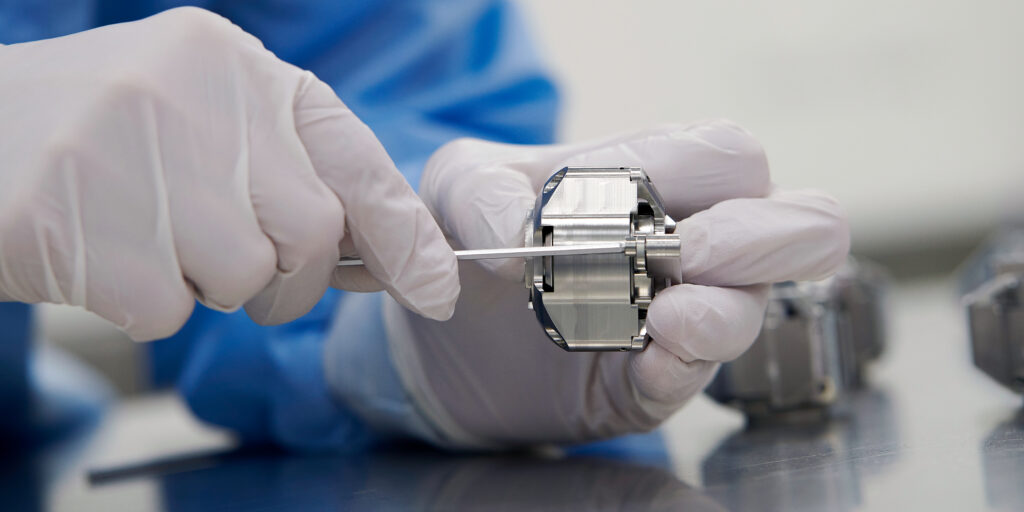
This also changes how cleanliness itself is approached. At CoreDux, purity is not treated as a final cleaning operation performed at the end of production. It is considered an integrated part of the entire manufacturing chain. Every process step, from engineering and material selection to welding procedures, cleaning methods and validation protocols contributes to the final cleanliness level of the product.
That integral approach becomes increasingly important as purity specifications move towards nano-level contamination control. At those levels, even seemingly insignificant factors can influence whether a product meets specification. A microscopic particle, an incorrect welding procedure or even external contamination during production can affect the final result.
Engineering determines achievable purity
This is also where engineering decisions become critical. In practice, design choices made early in development can directly determine whether ultra-high purity levels remain achievable later in manufacturing. According to CoreDux, engineers sometimes underestimate how strongly manufacturing methods influence final cleanliness performance. Selecting the wrong welding technology, for example, can prevent assemblies from ever reaching the required purity grade.
Consistency is the real benchmark
Ensuring consistency therefore goes beyond manufacturing capability alone.
It requires a combination of controlled production processes, statistical process control (SPC), cleanliness validation and continuous product verification. Especially in High Tech applications, consistency is not defined by producing a single compliant product, but by being able to reproduce the same performance level batch after batch.
And ultimately, that is what precision means in modern High Tech systems. Not simply achieving tight tolerances. But consistently eliminating uncertainty in environments where even the smallest deviation can directly affect system performance, uptime and reliability.