
As High Tech systems become increasingly specialised, the limitations of standardisation become more visible. Standard components and predefined solutions are often sufficient for conventional applications. But within advanced High Tech environments where multiple technical requirements converge simultaneously, engineering challenges quickly become too specific for off-the-shelf solutions alone.
This is where custom engineering and co-development become essential
At CoreDux, High Tech applications range from cryogenic cooling systems and electron microscopy to advanced laboratory equipment and complex vacuum environments. Each system introduces its own combination of requirements related to pressure, vibration, cleanliness, routing constraints, manufacturability and long-term reliability.
And in many cases, these challenges exist simultaneously.
A standardised solution may successfully solve one technical requirement, but fail to meet others within the same system architecture. That is typically the point where OEMs move beyond catalogue-based selection and enter a design trajectory. According to CoreDux, successful custom engineering does not start with designing a product.
The actual challenge
It starts with understanding the actual challenge behind the application need. In practice, customers often recognise the symptoms of a problem long before the root cause itself becomes fully clear. Vibration instability, whistling systems, thermal behaviour, contamination risks or integration limitations may become visible during operation, while the underlying system interaction remains difficult to isolate.
This is where engineering collaboration becomes valuable.
By combining application knowledge, manufacturing expertise and system integration experience, engineering teams can help identify how different variables influence each other within the total machine architecture. And that significantly changes the role of the supplier. The discussion is no longer limited to: which component is selected? But increasingly becomes:
- What is the actual engineering challenge?
- Which variables influence system behaviour?
- How can reliability be improved?
- How can vibrations be reduced?
- How can manufacturability remain scalable?
- How can integration risks be minimised?
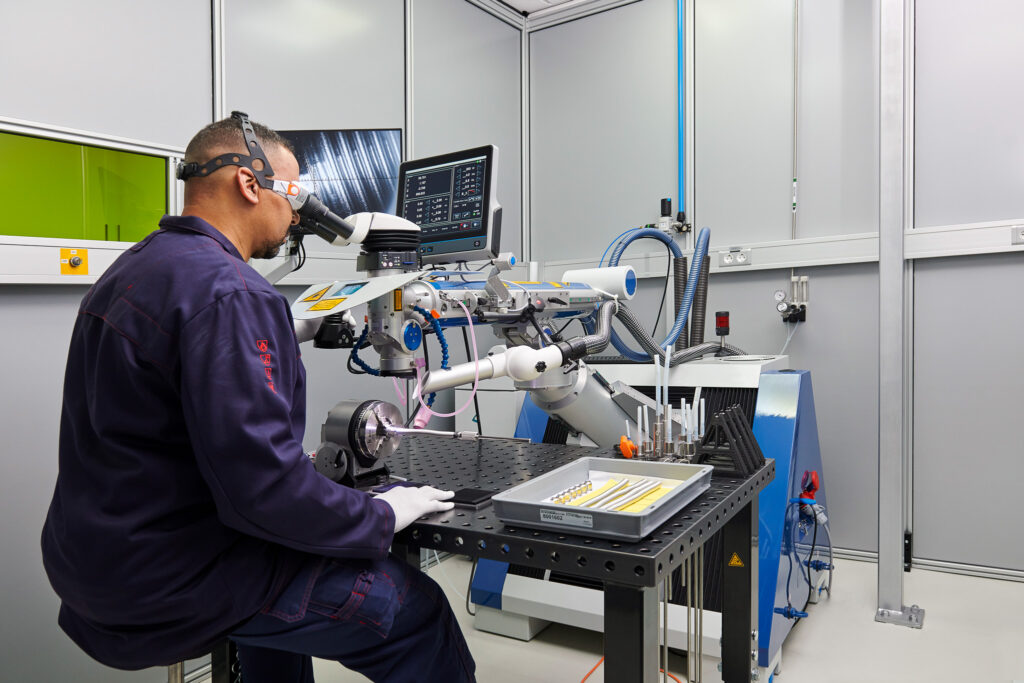
From vibration challenge to system performance
One example shared by CoreDux involved a customer experiencing vibration-related performance issues inside a critical High Tech system. The challenge was not simply the presence of vibration itself, but a very specific vibration bandwidth that interfered with the core process of the machine.
Within highly sensitive environments such as microscopy, semiconductor equipment or precision cooling systems, vibrations can directly affect measurement accuracy, process stability and overall system performance.
By analysing material behaviour, fatigue modes, system integration and damping characteristics, CoreDux worked together with the customer to isolate and reduce the problematic vibration range, ultimately improving machine output and operational stability.
This illustrates an important shift within modern High Tech engineering environments. Customers increasingly expect suppliers not only to manufacture according to specification, but also to actively contribute knowledge related to integration, manufacturability and system behaviour.
Two engineering disciplines, one development partner
At CoreDux, this capability is described as “Dual Competence, Single Source.”. It brings together two complementary engineering domains within one organisation:
- Component engineering & manufacturing
- Higher-level system integration
By combining these capabilities under one roof, customers benefit from a single engineering and manufacturing partner that supports the complete development process from individual components to fully integrated system solutions.
From component engineering to system integration
This means customers no longer need to coordinate multiple specialised suppliers separately in order to develop integrated transport solutions. Instead, engineering, manufacturing and integration expertise are combined within a single development environment.
That directly affects:
- Engineering speed
- Communication efficiency
- Manufacturability
- Scalability
- Time-to-market
- Long-term reliability
At the same time, scalability remains a critical part of custom engineering itself. A technically functional prototype is not automatically a volume ready manufacturable solution. Designs must also remain reproducible, repeatable and scalable throughout serial production.
This is why manufacturability analysis already starts during the earliest engineering phases.
- Can the solution be produced consistently?
- Can quality remain stable batch after batch?
- Can the design remain economically scalable over time?
Those questions increasingly determine whether custom engineering truly creates long-term value. Because in High Tech environments, successful engineering is not defined by complexity alone. It is defined by the ability to translate complex technical challenges into scalable, reliable and manufacturable solutions.