
High Tech systems are becoming increasingly advanced, interconnected and performance driven. But as machines become more complex, the engineering challenge is no longer defined by a single technology or component.
It is defined by how multiple disciplines interact within one integrated system. Flow dynamics, pressure, temperature, vibration, cleanliness and manufacturability all converge inside modern High Tech equipment. And in many cases, those variables are directly connected to the performance and stability of the machine itself.
Every application introduces new engineering challenges
High Tech applications for customers of CoreDux range from electron microscopes and MRI systems to datacentre cooling and cryogenic cooling solutions for quantum technology. Each system introduces its own operating conditions, performance requirements and engineering constraints.
Some systems require extreme cleanliness levels. Others operate under vacuum conditions, high vibration loads or ultra-low temperatures. In many applications, several of these challenges exist simultaneously. And that immediately changes the role of gas, liquid and vacuum transport systems within the machine architecture.
Transport systems are part of the machine architecture
These systems are not simply supporting infrastructure added at the end of the design process. They are directly linked to cooling performance, contamination control, system stability and long-term reliability.
As a result, transport systems cannot be viewed in isolation from the overall machine architecture.
Within complex High Tech machines, different submodules often operate under different technical requirements. The closer systems move towards the core technology of the machine, the more stringent those requirements become. Cleanliness levels increase, tolerances become tighter and integration complexity grows significantly. This also explains why manufacturability becomes such an important part of the engineering process.
A solution that can only be produced once is not necessarily a successful design. In High Tech environments, systems must be manufacturable repeatedly, consistently and at scale while maintaining the same quality and performance levels.
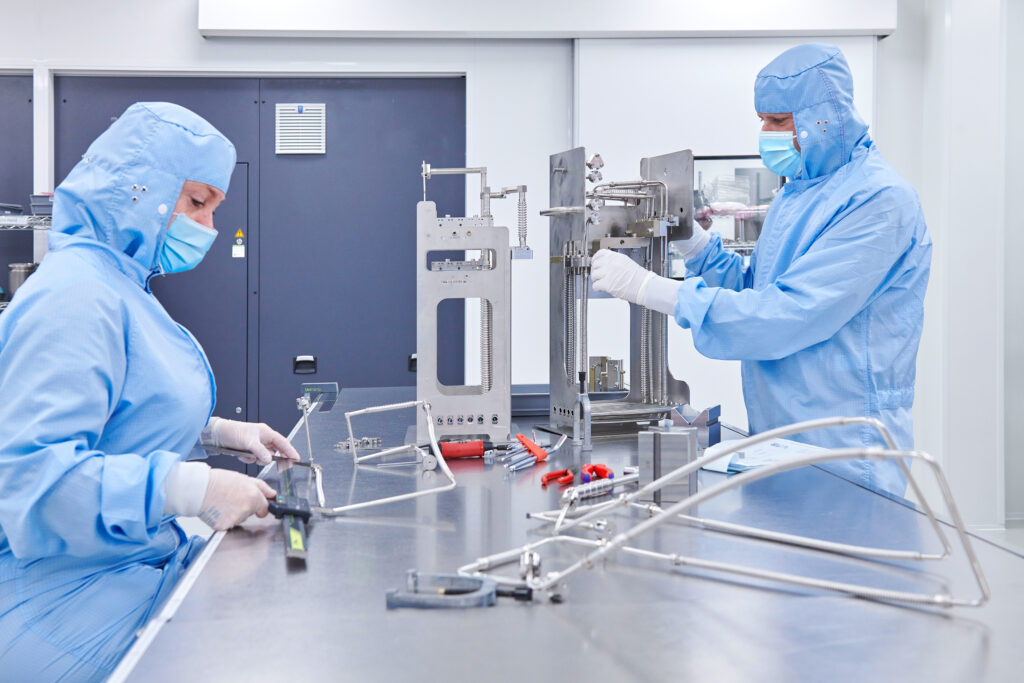
Flexibility becomes a design requirement
That challenge often becomes visible only later in the development process.
In practice, hose and piping assemblies, bellows and integrated transport systems are frequently designed relatively late in machine development. The machine’s core technology is prioritised first, while the transport systems become the connecting layer between multiple modules.
But this also means these systems are among the first elements affected when machine designs change. As architectures evolve, transport systems need to remain flexible enough to adapt quickly to new layouts, routing constraints, vibration behaviour or thermal conditions. That requires a highly agile engineering and manufacturing organisation.
Early engineering prevents later problems
This is also where early supplier involvement becomes increasingly valuable.
According to CoreDux, the earlier engineering specialists are involved in the design process, the greater the ability to prevent issues later in production, integration and scalability.
Design choices that initially seem logical can create major challenges later in manufacturing. Certain routings may be difficult to reproduce consistently. Improper material selections may reduce scalability. Specific assembly methods may increase cost, integration complexity or long-term reliability risks.
By contributing early in the conceptual phase, engineering partners can help OEMs better understand the consequences of specific design decisions before they become locked into the system architecture.
Beyond build-to-print manufacturing
This is also where the difference between “build-to-print” manufacturing and true engineering partnership becomes visible.
In a traditional build-to-print model, suppliers are primarily responsible for manufacturing excellence and adhering to the specification. Their visibility into the broader system context is often limited.
But when suppliers are actively involved during development, they can contribute knowledge related to manufacturability, scalability, integration behaviour and long-term system performance.
That changes the relationship entirely. The discussion is no longer limited to: Can this be manufactured? It increasingly becomes:
- Can this be manufactured repeatedly?
- Can this scale?
- Can this remain reliable over time?
- Can this reduce integration risk?
- Can this optimize system performance?
And that is where the role shifts from component supplier to engineering partner.
At CoreDux, this collaboration increasingly takes place in close cooperation with High Tech OEMs that rely on deep expertise in gas, liquid and vacuum transport systems and layout designs.
Because in modern High Tech platforms, successful system design is no longer about optimising individual components. It is about ensuring every subsystem contributes reliably to the performance of the machine as a whole.