
Engineering flexibility in constrained assemblies
How can hose systems be engineered to accommodate misalignment and tolerance issues in confined or complex assemblies?
In real-world applications, perfect alignment is the exception rather than the rule. Manufacturing tolerances, installation constraints and system movement continuously introduce deviations between connection points.
Flexible hose systems exist to solve exactly these challenges. Where rigid piping requires precision, hoses introduce controlled flexibility. Not only to absorb dynamic movement, but also to compensate for misalignment that cannot be resolved through design or installation alone.
Yet misalignment is often underestimated. When not properly engineered, it introduces unintended stresses, reduces lifetime and can ultimately lead to premature failure.
Why misalignment is more complex than it seems
Misalignment is not a single-direction problem. In practice, deviations occur across multiple axes simultaneously.
A single hose assembly can accommodate movement in two planes (for example X and Y). Within this range, bending is controlled and predictable. However, when misalignment occurs in three planes (X, Y and Z), the situation fundamentally changes.
A single hose is not designed to absorb torsion. When forced into three dimensional compensation, torsional stress is introduced. This leads to internal strain, accelerated fatigue and a significant reduction in service life.
In confined or complex assemblies, where space is limited and routing options are restricted, this risk increases even further. What appears to be a flexible solution can unintentionally become a failure mechanism.
Engineering misalignment as a system solution
At CoreDux, misalignment is approached as a system-level engineering challenge.
The key is not to force a single hose to solve a three-dimensional problem, but to design a configuration that distributes movement in a controlled way.
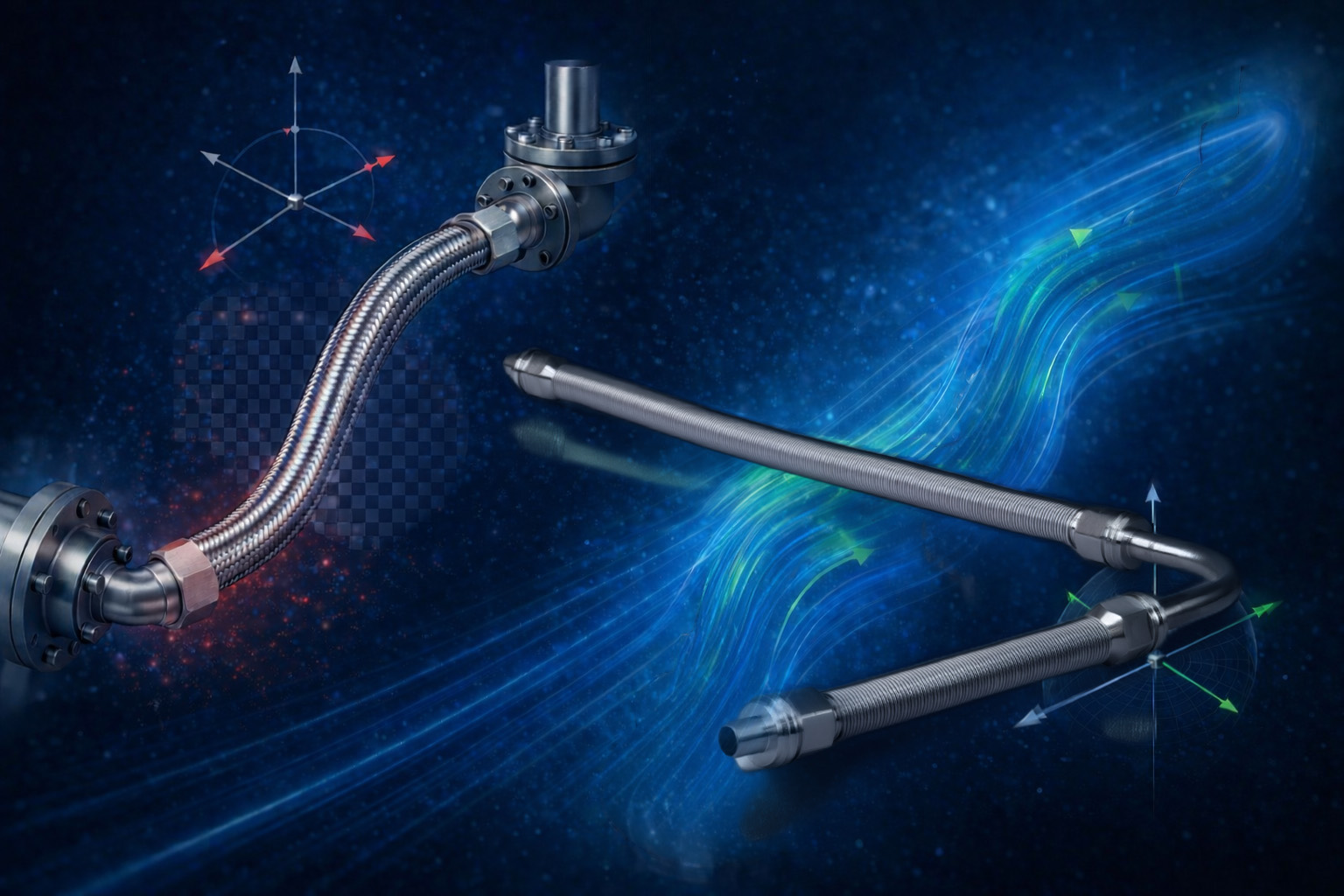
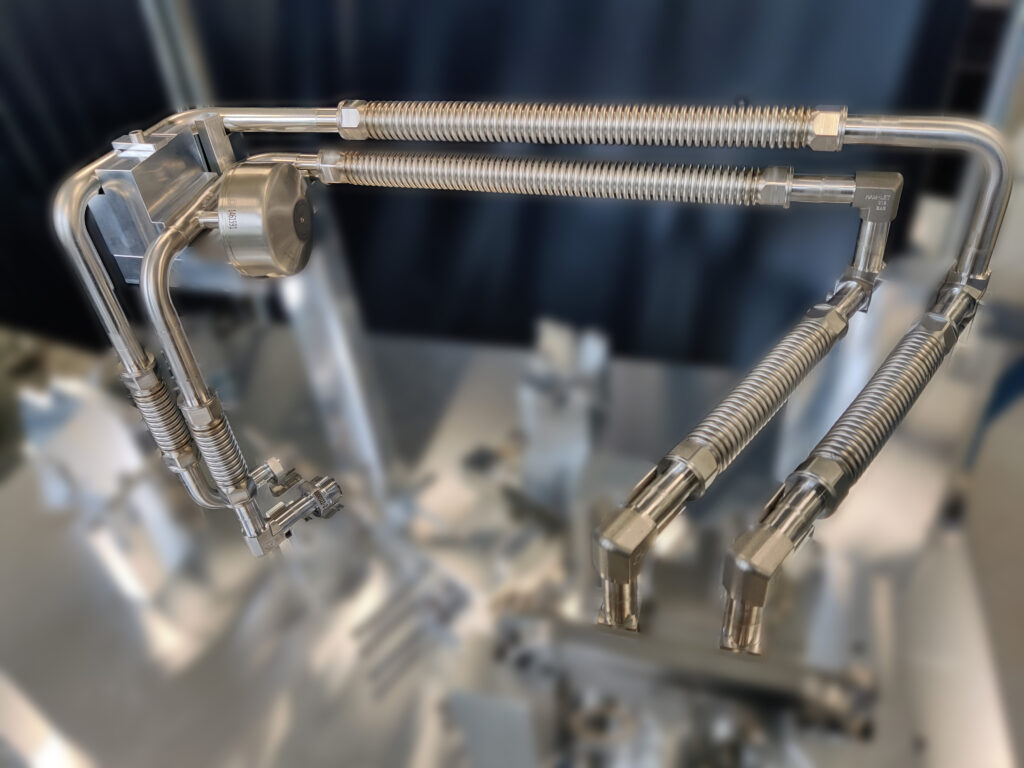
When misalignment occurs in three planes, a dogleg solution can be applied. This configuration combines two hose assemblies with a 90-degree elbow or micro-fit component. By introducing a directional break in the system, each hose absorbs movement within its optimal plane.
This eliminates torsional loading and allows the system to accommodate complex misalignment in a controlled and reliable manner.
Engineering such solutions requires more than selecting a flexible component. It demands alignment between:
- Hose construction and flexibility characteristics
- Routing and spatial constraints
- Connection geometry and boundary conditions
Only by considering these parameters together can misalignment be resolved without compromising performance.
Conclusion: controlled flexibility prevents uncontrolled stress
Misalignment and tolerance deviations are inherent to real-world systems. Attempting to eliminate them entirely is neither practical nor cost-effective. The solution lies in engineering flexibility with intent.
By understanding the limits of single hose assemblies and applying system-level solutions such as dogleg configurations, misalignment can be accommodated without introducing torsion, fatigue or premature failure.
In short, flexibility is not just about movement. It is about controlling how that movement is absorbed.
Are you dealing with misalignment challenges in a confined or complex assembly? Our engineers are ready to explore the challenge with you.