
Balancing thermal resistance and pressure performance
What type of hose is best for high temperatures?
In high-temperature environments, hose selection is not just about withstanding heat. It is about maintaining performance under combined thermal and pressure conditions.
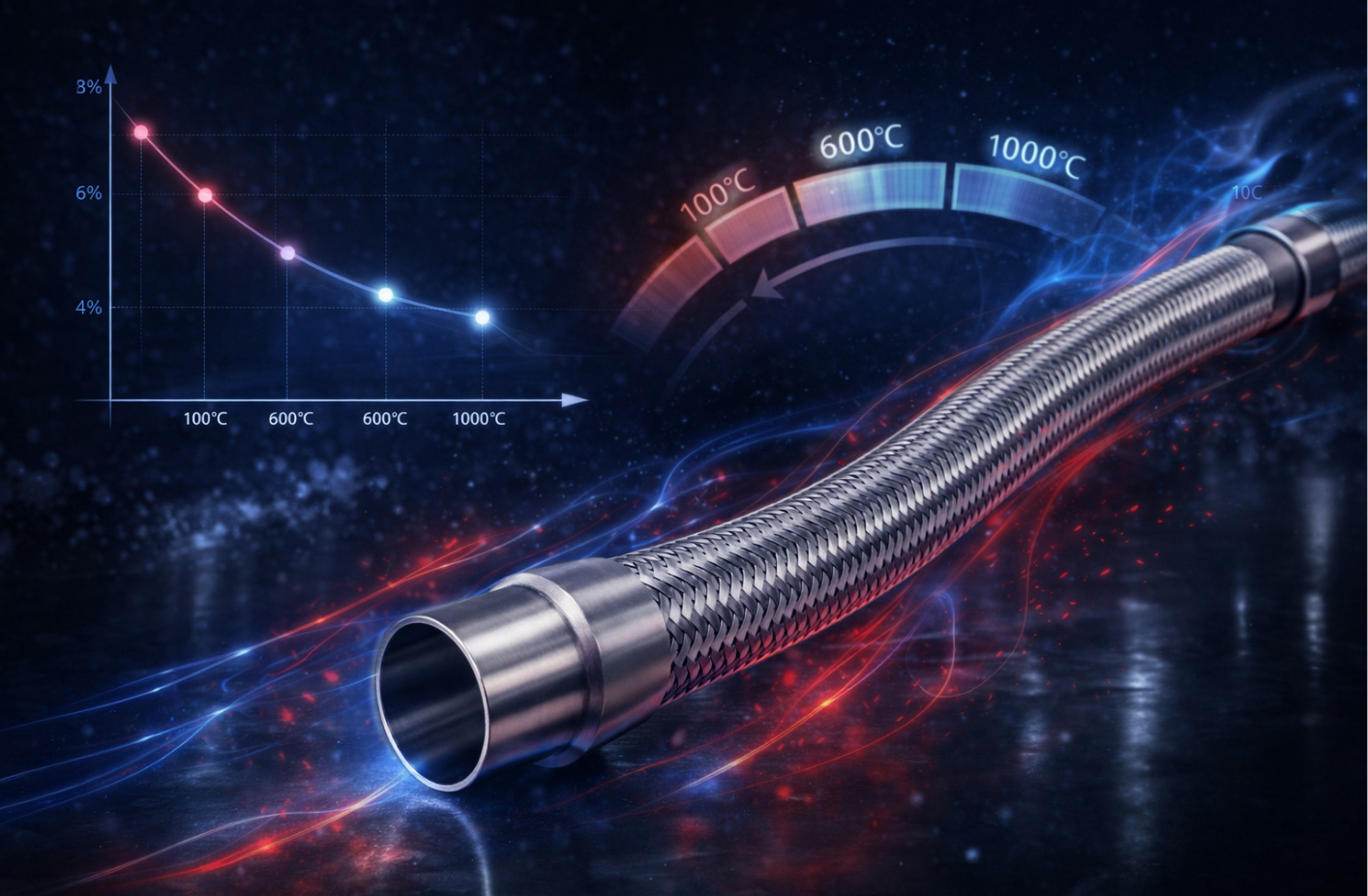
Stainless steel hoses are commonly applied for elevated temperatures and can typically operate up to approximately 600°C. For more extreme conditions, exotic alloys can extend this range towards 1000°C. However, selecting a material based on temperature resistance alone is insufficient.
At elevated temperatures, material strength decreases. This directly impacts
pressure resistance.
Why temperature affects pressure performance
As temperature increases, the allowable working pressure of a hose decreases. This effect is defined by temperature derating factors, as specified in standards such as ASME and PED. Derating typically starts around 100°C and progressively reduces the maximum allowable pressure as temperature rises.
This means:
- A hose rated for a specific pressure at ambient conditions will not maintain that rating at higher temperatures.
- Material selection, wall thickness and construction must compensate for this loss of strength.
- The combination of temperature and pressure defines the real operating window.
- In high-temperature applications, pressure cannot be treated as a fixed parameter.
Engineering high-temperature performance as a system challenge
At CoreDux, high-temperature performance is approached as a system-level engineering challenge.
The key question is not: “Which hose can handle the temperature?” But: “What pressure resistance is
required at which temperature?”
This requires alignment between:
- Material properties and thermal limits
- Pressure requirements across the full temperature range
- Hose construction and safety factors
- Applicable standards (ASME, PED)
Only by combining these parameters can a reliable and safe solution be defined.
Conclusion: controlled flexibility prevents uncontrolled stress
High-temperature applications demand more than heat-resistant materials. They require a precise balance between temperature and pressure performance. Ignoring temperature derating leads to overestimated capabilities, reduced lifetime or even failure.
In short:
- Thermal resistance defines the limit.
- Pressure defines the risk.
- Engineering defines the solution.
Are you dealing with high-temperature challenges in your application? Our engineers are ready to explore the challenge with you.