
In High Tech industries, uptime is far more than a technical performance metric. It directly affects productivity, operational continuity, output quality and financial performance. Whether it concerns quantum technology, medical systems, electron microscopy or advanced laboratory environments, these systems are designed to operate under highly controlled conditions where stability and continuity are essential.
When critical systems stop performing
… the impact extends far beyond the failed component itself.
Production processes are interrupted. Investigations are initiated. System behaviour must be analysed. And depending on the application, the operational and financial consequences can become enormous.
That is why reliability is engineered throughout the entire system lifecycle. Within modern High Tech equipment, gas, liquid and vacuum transport systems contribute directly to maintaining stable operating conditions. These systems support cooling performance, pressure stability, contamination control and sensitive process environments where even small deviations can influence overall machine behaviour. Leakage, contamination, wear or pressure instability are therefore never treated as isolated technical issues.
In highly demanding environments, every subsystem contributes to the operational stability of the machine as a whole. This also explains why modern High Tech manufacturing environments rely heavily on system validation, site qualification and traceability procedures.
Reliability is not simply assumed after production. It is continuously verified throughout manufacturing, integration and final system qualification.
Reliability is validated at every level
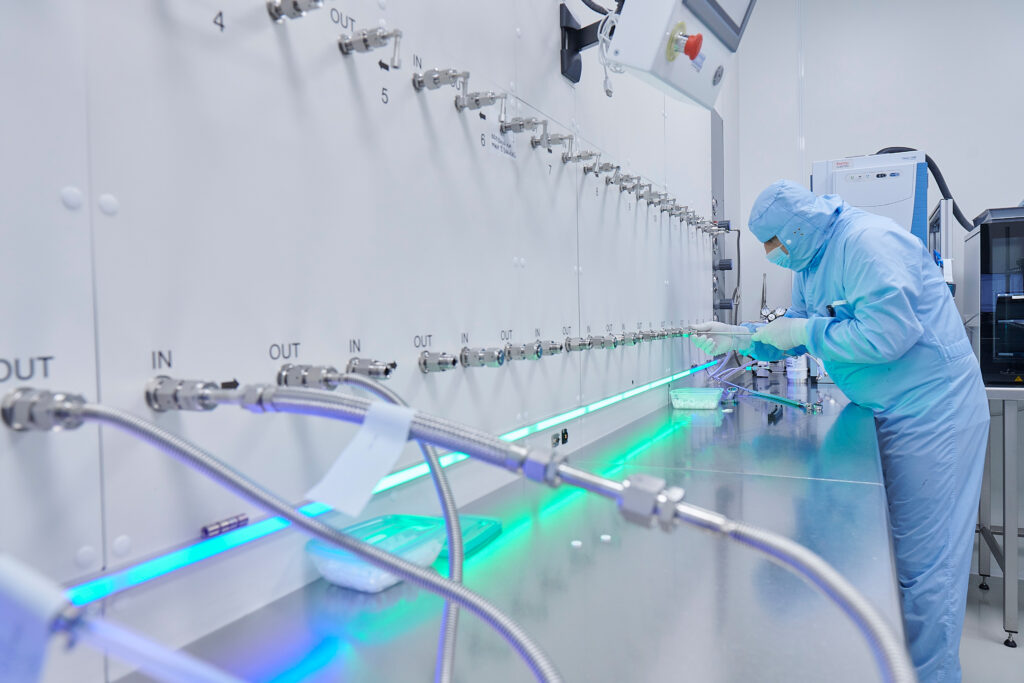
At CoreDux, assemblies are leak tested and validated before moving into higher-level integration. But validation continues throughout the complete machine architecture. Integrated modules are tested again after assembly, while fully assembled systems undergo extensive functional and reliability verification at OEM level.
Within High Tech manufacturing, final qualification is typically performed at machine level rather than individual component level.
OEMs validate whether complete systems perform according to specification before machines are released for operation or installed at customer sites. This process often includes:
- Leak testing
- Cleanliness validation
- Functional testing
- Performance verification
- Factory Acceptance Tests (FAT)
- Site Acceptance Tests (SAT)
Only after these stages are successfully completed, systems can be considered operationally qualified. The reason for this level of control is straightforward: failure inside critical High Tech environments is rarely treated as a minor incident.
According to CoreDux, when systems fail, customers immediately investigate the complete chain to determine the exact root cause. Especially in environments where uptime is directly linked to productivity and operational output, traceability becomes essential throughout the entire supply chain.
This means production steps, material batches, assembly methods and validation procedures often need to remain fully traceable throughout the complete lifecycle of the product. Whether it concerns welding procedures, adhesive applications, compression fittings or cleanliness verification, OEMs increasingly require complete visibility into how products were manufactured, assembled and verified.
Long-term reliability is engineered, not assumed
It is about ensuring systems continue to perform consistently over time, under demanding operational conditions.
According to CoreDux, there is an important difference between a solution that works during installation and a solution that remains reliable after years or even decades of operation.
That long-term reliability depends on a combination of:
- Engineering/Design quality
- Material Quality
- Material behaviour
- Manufacturing consistency / repeatability
- Validation discipline
- Application expertise
Products must not only meet specification during qualification, but continue performing throughout the operational lifetime of the machine itself.
This is why reliability within High Tech manufacturing is increasingly approached as a system-level engineering discipline rather than a standalone product characteristic. In environments where downtime is unacceptable, uptime is never accidental. It is engineered into the system from the very beginning.