
Enabling controlled flexibility in Semiconductor systems
What are the primary applications of flexible hoses in the Semiconductor industry?
In Semiconductor equipment and Semiconductor FABS, flexible hose assemblies are used for the transportation of gas, liquids and vacuum. Here, rigid piping alone is not suitable.
This is not simply a matter of convenience. Semiconductor systems operate in highly controlled, compact and dynamic environments where movement, vibration, thermal expansion and serviceability must all be considered during system design.
Rigid piping offers stability, but lacks the flexibility required to accommodate real-world operational and integration challenges.
Flexible hose assemblies help engineers create reliable connections between modules, subsystems and process equipment without compromising system integrity, cleanliness or performance.
Typical applications include:
- Gas, liquid and vacuum process lines
- Systems exposed to movement or vibration
- Service-sensitive installations
In Semiconductor environments, flexibility is not a secondary feature. It is often a functional system requirement.
Why Semiconductor systems require flexibility
Semiconductor capital equipment often consists of multiple modules, complex routing paths and tightly integrated subsystems. Throughout transportation, installation, operation and maintenance, these systems are subjected to mechanical and thermal influences that rigid piping alone cannot always
accommodate safely.
Common engineering challenges include:
- Vibration dampening between modules
- Misalignment tolerances between modules
- Pressure pulsations
- Thermal expansion and temperature changes
- Dynamic movement during operation
- Serviceability and accessibility constraints
- Complex onsite routing
Without controlled flexibility, these influences can introduce stress into the system, potentially affecting reliability, sealing performance or component lifetime. Flexible hose assemblies are therefore engineered to absorb movement, compensate tolerances and protect the integrity of the complete system.
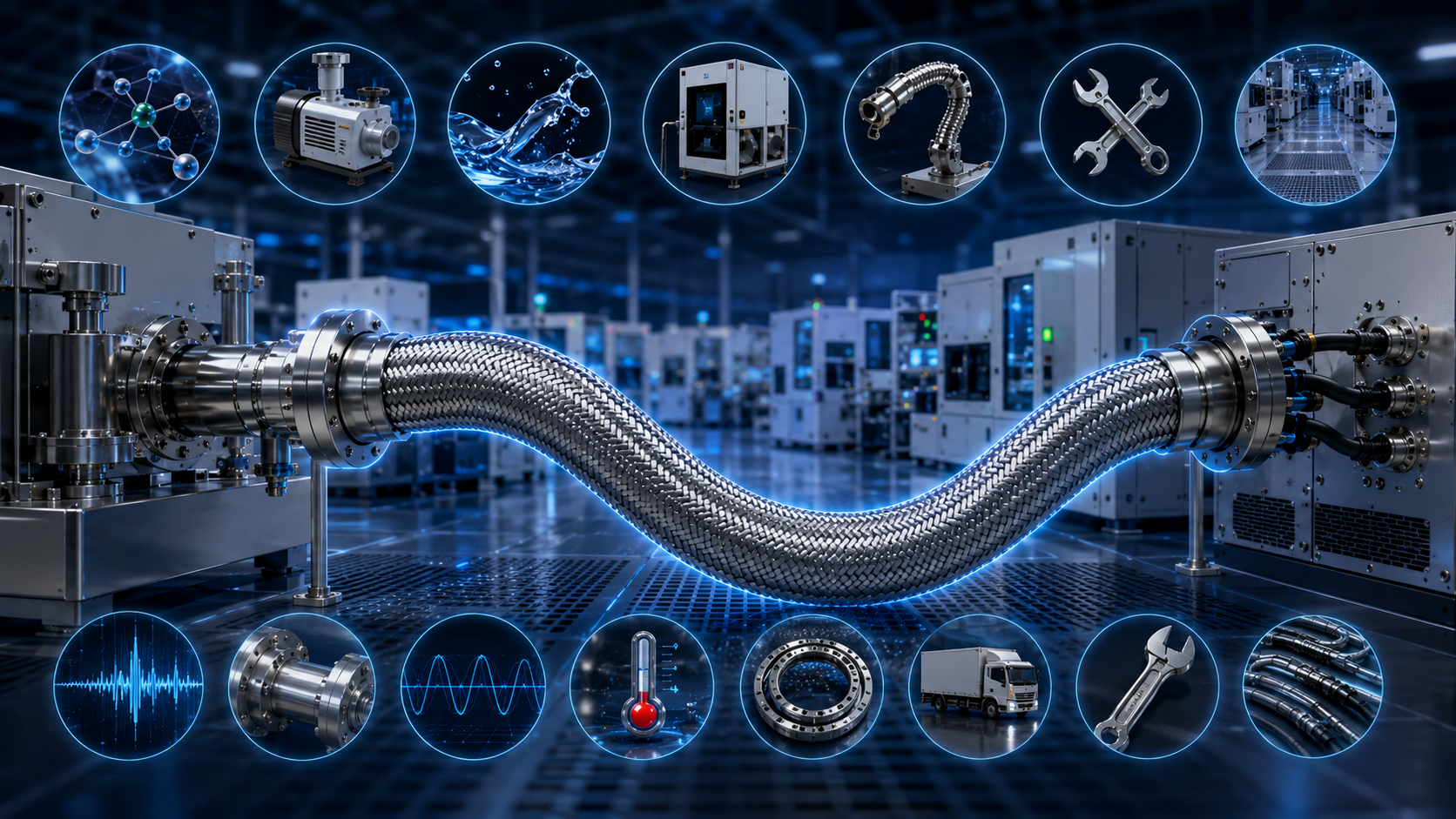
Engineering flexibility as a system property
At CoreDux, flexibility is approached as a system-level engineering challenge. The objective is not flexibility by itself, but maintaining controlled system performance under mechanical, thermal and operational influences.
This requires alignment between:
- Hose construction and flexibility
- Pressure and vacuum requirements
- Gas and liquid compatibility
- Temperature conditions
- Cleanliness and contamination control
- Routing complexity and installation ease
- Dynamic loads and vibration behaviour
In Semiconductor applications, flexibility can never compromise purity, leak tightness or vacuum compatibility. That is why hose assemblies must be engineered as part of the complete transportation system rather than as individual components.
Conclusion: controlled flexibility prevents uncontrolled stress
Flexible hose assemblies play a critical role in Semiconductor equipment and FABS where gas, liquid and vacuum systems must operate reliably under dynamic conditions.
They help engineers manage vibration, movement, thermal changes, routing complexity and module tolerances while safeguarding system integrity and long-term performance.
In short:
- Rigid piping provides structure.
- Flexible hose assemblies provide control.
- Engineering defines the balance between both.
They require a precise balance between temperature and pressure performance. Ignoring temperature derating leads to overestimated capabilities, reduced lifetime or even failure.
Are you dealing with routing or integration challenges in Semiconductor equipment? Our engineers are ready to explore the challenge with you.